The Bodymind Ballwork Method by Ellen Saltonstall
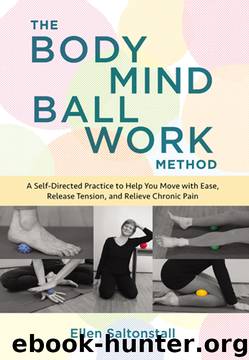
Author:Ellen Saltonstall
Language: eng
Format: epub
ISBN: 9781623172916
Publisher: North Atlantic Books
Published: 2018-08-25T16:00:00+00:00
Ball Placement for the Trapezius
3. The Spine with Two Balls
With this technique, you can reach the large muscles of the middle and lower back that are often the source of fatigue and pain. Use it in combination with The Trapezius technique (above) and The Back of the Pelvis technique (below) if you want to work from the shoulders down through the pelvis. As a daily practice, this one will help to prevent incipient musculoskeletal back problems from developing, and your breathing will improve.
Balls: Two balls, either 2.5˝ solid balls or 3˝–4˝ hollow balls (smooth or spiky). Solid balls will penetrate more, so choose those if you like deep pressure. Hollow balls will still loosen your muscles, but with less intense pressure.
Body position: Lying on your back, with your knees bent or straight, whichever is more comfortable for you
Starting position of the balls: Just below your shoulder blades, one on each side of the spine
Action: Settle yourself on the balls, taking several deep breaths. Then begin to move your spine and ribs very slowly to one side. Take your time and feel each small gradation of movement. Then return to center and pause to breathe. Slowly move to the other side, moving only that part of your spine and ribs. Do as many repetitions from side to side as you wish. Try to move just the part of the spine where the balls are touching, and avoid pushing with your legs.
Progression: Move the balls down an inch or two on your back, either with your hands or by letting them roll as you shift your body in the direction of your head. Repeat the movements at this new spot. Continue down your entire spine, one spot at a time, until you feel the top of your pelvis in contact with the balls.
Be attentive to your breath, especially when working in the midback, near the diaphragm.
Duration: 15–20 minutes
Contraindications: Recent disk herniation, or spinal fracture. For those with spinal stenosis and scoliosis: My experience is that this technique is very beneficial, but I encourage you to use your own best judgment. Try it for a few sessions and see if you feel more ease in your posture and movement.
Notes: You may need one type of ball on the upper part of the spine and a different type lower down, due to the tension patterns in your back. Feel free to change the balls if necessary.
Anatomy: Thoracic and lumbar vertebral segments, the erector spinae and quadratus lumborum muscles, the lumbosacral fascia, and indirectly the diaphragm muscle and the iliopsoas muscle
The Spine with Two Balls
Download
This site does not store any files on its server. We only index and link to content provided by other sites. Please contact the content providers to delete copyright contents if any and email us, we'll remove relevant links or contents immediately.
Becoming Supernatural by Dr. Joe Dispenza(8223)
Crystal Healing for Women by Mariah K. Lyons(7933)
The Witchcraft of Salem Village by Shirley Jackson(7277)
Inner Engineering: A Yogi's Guide to Joy by Sadhguru(6798)
The Four Agreements by Don Miguel Ruiz(6767)
The Power of Now: A Guide to Spiritual Enlightenment by Eckhart Tolle(5788)
Secrets of Antigravity Propulsion: Tesla, UFOs, and Classified Aerospace Technology by Ph.D. Paul A. Laviolette(5373)
The Wisdom of Sundays by Oprah Winfrey(5165)
Room 212 by Kate Stewart(5129)
Pale Blue Dot by Carl Sagan(5012)
Fear by Osho(4741)
The David Icke Guide to the Global Conspiracy (and how to end it) by David Icke(4721)
Animal Frequency by Melissa Alvarez(4475)
Rising Strong by Brene Brown(4465)
How to Change Your Mind by Michael Pollan(4358)
Sigil Witchery by Laura Tempest Zakroff(4248)
Man and His Symbols by Carl Gustav Jung(4138)
The Art of Happiness by The Dalai Lama(4132)
Real Magic by Dean Radin PhD(4131)
